 User Guide — Scan Vaccine Barcodes
You can use a handheld scanner to scan 2D Data Matrix barcodes on vaccine packages, vials, syringes, and vaccine information statements (VISs). athenaOne analyzes the scanned data and inserts available details, such as the NDC, lot number, manufacturer, and expiration date, in the vaccine administration order. For VIS barcodes, athenaOne captures the VIS statement name and publish date.
Barcode scanning reduces manual data entry and improves the accuracy of captured vaccine data. You can also test scanner performance from the vaccine scanning workflow.
Note: athenaOne does not support the use of 1D or linear barcode scanners.
Important: Always verify the data captured before you save vaccine details to a patient's medical record.
For information about supported barcode and card scanners, see the How-to Guide: Vaccine and Barcode Scanner on the Success Community.
 Step-by-step instructions
To enable the vaccine barcode scanner on the Device Management page
Before you scan vaccine barcodes, make sure the Vaccine Barcode Scanner device is active on the Device Management page. An administrative user can enable the scanner for all departments or only selected departments.
Only administrative users can add or edit the vaccine barcode scanner on the Device Management page.
- Display the Device Management page: On the Main Menu, click Settings
 > Device Management.
Note: If your practice has used the vaccine barcode scanner previously, the device is already listed in the Devices table. - If the vaccine barcode scanner is not listed in the Devices table, click Add new.
Additional fields appear. - Device - Select Vaccine Barcode Scanner.
- Departments - Click All to use the device in all departments, or click Selected to choose the departments that can use the device.
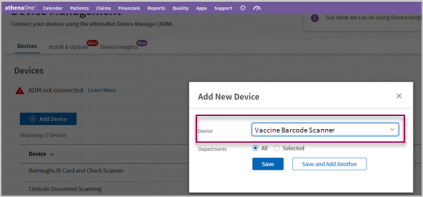
- Click Save.
To scan a vaccine in the Assessment / Plan section
Note: You can also scan a vaccine barcode in the document view of the order for vaccines that were ordered earlier in the encounter or in a different encounter.
Note: You can scan 2D Data Matrix barcodes on a vaccine vial, syringe, or outer package. For vaccines ordered as a kit or that require reconstitution, such as Pentacel or MENVEO, scan the outer package when available.
Note: You can scan barcodes for vaccines that are dispensed in two separate vials (for example, Pentacel, which is supplied in one vial containing DTaP-IPV and another vial containing HiB, and requires combining the contents of the two vials into a single syringe at the time of administration) by scanning the barcode on the box instead of the barcode on the vial. The CDC continues to work with vaccine manufacturers to improve barcoding consistency for these vaccines, in the meanwhile, for multi-disease vial vaccine preparation, please scan the barcode on the box instead of the barcode on the vial.
- In the Exam stage of the patient encounter, click A/P in the navigation bar.
- Click the plus icon
 next to Diagnoses & Orders.
- Search for and select the vaccine.
- Click the new vaccine order to expand the details.
- Click the Administer tab and then click VIEW MORE at the bottom of the order details.
- Click Scan Package Barcode.
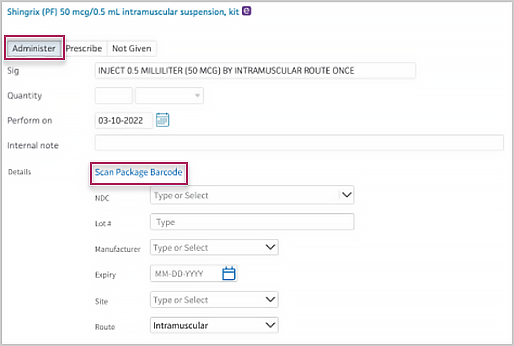
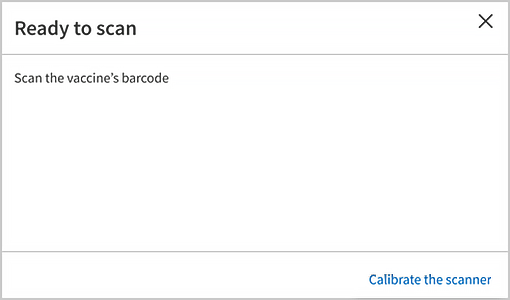
- When the Ready to scan message appears, scan the 2D barcode with your handheld scanner.
The NDC, Lot #, Manufacturer, and Expiry fields are populated automatically if the corresponding data is available. You can edit these fields if necessary.
Note: If you scan a new barcode, the NDC, Lot #, Manufacturer, and Expiry fields are overwritten. - Review the information that appears in the NDC, Lot #, Manufacturer, and Exp Date fields before you save the order.
- Repeat the scan workflow to capture multiple vaccine events, if needed.
Important: Always verify the data captured before you save vaccine details to a patient's medical record.
You receive an error message if you:
- Scan a vaccine that does not match the order
- Scan the wrong barcode type
- Scan an expired vaccine
- Overwrite existing data
- Scan a barcode with data that your scanner is not configured to transmit
If the barcode on the vial or syringe does not scan, try scanning the barcode on the outer package. You may also receive errors due to an NDC mismatch when the NDC code in the vaccine order is not the same as the NDC for the vaccine available to administer to a patient. Change the vaccine in the order to match the vaccine available for administration.
Features and workflows
As a provider or staff member who administers vaccines, you can use barcode scanning to capture vaccine details in orders and reduce the likelihood of manual entry errors.
Barcode types supported
Vaccine packages and vaccine information statements (VISs) support 2D Data Matrix barcode scanning.
- Vaccine packages can be encoded with the NDC, manufacturer, lot number, expiration date, or a combination of those details.
- Vaccine information statements published and maintained by the CDC can be encoded with the statement name and publish date. In hospital MAR workflows, scanning a VIS can capture these details for vaccine administration documentation.
- If the barcode on the vial or syringe fails to scan, try scanning the barcode on the outer package.
- If a 2D barcode is not available on the vial or syringe, scan the barcode on the outer package.
- For vaccines ordered as a kit or that require reconstitution, such as Pentacel or MENVEO, scan the outer package when available.
Example of a 2D barcode:

General tips for using scanners
The CDC encourages vaccine manufacturers to affix 2D barcodes to vaccine vials and packages. Most medical device quality 2D scanners work with athenaClinicals. You can review the CDC's growing list of vaccines that have 2D barcodes here: http://www.cdc.gov/vaccines/programs/iis/2d-vaccine-barcodes/.
Note: Please refer to the user guide that came with your device for additional tips that are specific to your scanner.
- Select a scanner that matches athenahealth's tested device list.
- Before investing in multiple scanners of a given make or model, scan a variety of vaccine types to test performance.
- If purchasing multiple scanners, invest in the same make and model to reduce performance variability across devices.
- Test performance across all organization-supported internet browsers.
- For scanning flexibility, consider device models that support both wired and wireless modes.
- Locate and save user manuals for scanners to reference as needed.
- Register scanners with the manufacturer for warranty and device support.
- Make sure the room is well lit.
- Position the vial or package so that nothing is directly behind the barcode. Do not hold the barcode against a wall, a piece of paper, or another object.
- Hold the scanner at various distances from the barcode to determine which distance works best with your scanner.
- If your scanner projects cross hairs, position them in the middle of the barcode.
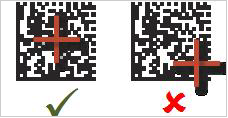
- Hold your hand steady when you press the scanner button.
Scanner requirements and tested devices
Use a device with 2D scanning support that is configured to read the GS1 Data Matrix barcodes used by the healthcare industry. You cannot scan vaccine barcodes using retail slot scanners, laser scanners, 1D scanners, or linear array imagers.
- Ability to recognize and translate Data Matrix (2D) barcodes
- USB connector cable
- Ability to set up as a keyboard wedge, a device that translates readings from the barcode scanner into keyboard strokes
- Ability to scan using a trigger
- Medical device quality, disinfectant ready (recommended)
athenahealth uses the following device makes and models to test vaccine scanning workflows:
Verified as working out of the box without configuration:
- Zebra DS4600 series
- Wasp WDI4200
Requires additional scanner configuration for complex barcodes:
- Honeywell Xenon 1950
Note: See the online manual to enable Windows Control-X Mode (KBDCAS2) and optimize scanning results.
Setup instructions
Before you scan vaccine barcodes, make sure the Vaccine Barcode Scanner device is active on the Device Management page. An administrative user can enable the scanner for all departments or only selected departments.
Only administrative users can add or edit the vaccine barcode scanner on the Device Management page.
- Display the Device Management page: On the Main Menu, click Settings > Device Management.
Note: If your practice has used the vaccine barcode scanner previously, the device is already listed in the Devices table. - If the vaccine barcode scanner is not listed in the Devices table, click Add new.
Additional fields appear. - Device - Select Vaccine Barcode Scanner.
- Departments - Click All to use the device in all departments, or click Selected to choose the departments that can use the device.
- Click Save.
Set up the scanner as a keyboard wedge, a device that translates readings from the barcode scanner into keyboard strokes. For most computers, you do this by connecting the scanner to your computer with a USB cable and accepting all the default selections as your operating system installs the device.
Please refer to the user guide that came with your barcode scanner for detailed instructions.
Check scanner performance using calibration
To check scanner performance before scanning a vaccine, click Calibrate the scanner on the Ready to scan page.
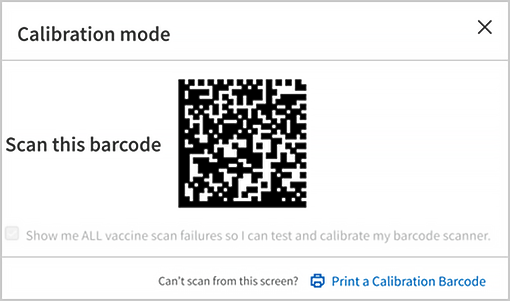
Print the calibration barcode and scan it, or scan the calibration code on the screen. Your calibration test results appear.
A successful test indicates that athenaOne was able to recognize the data received from your scanner.
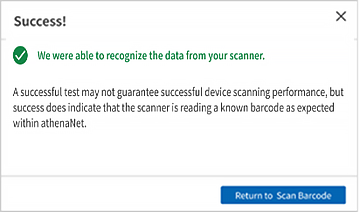
If athenaOne is unable to calibrate, you can select the option to prevent athenaOne from prompting you to calibrate again as you scan for a given vaccine type. Scan as you normally would, but verify that the captured data is accurate before saving the data to a patient's chart.
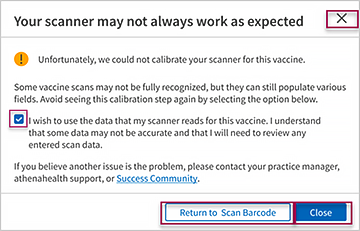
Important: Always verify the data captured before you save vaccine details to a patient's medical record.
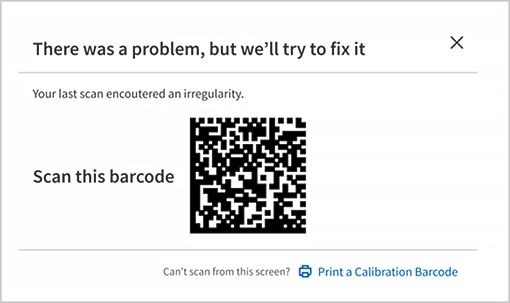
In some cases, athenaOne detects a scanner irregularity and automatically launches calibration mode. Scan the barcode on the screen or print the calibration barcode page.
To opt out of automatic calibration testing going forward, select the option and click Return to Scan Barcode or close the screen.
To restore calibration testing after opting out, click Calibrate the scanner on the Ready to scan page.
Select the Show me ALL vaccine failures so I can test and calibrate my barcode scanner option to enable calibration.
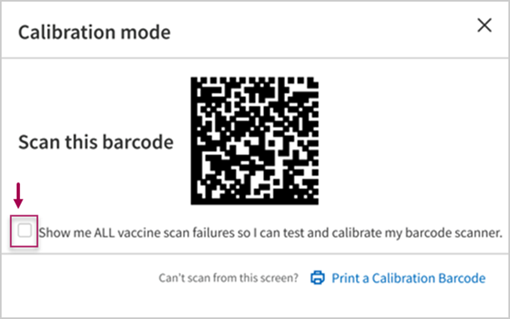
If athenaOne detects a problem, a message appears requesting calibration to resolve the issue.
Frequently asked questions
Q: What is the advantage of scanning?
A: Barcode scanning reduces manual data entry and improves accuracy in the vaccine data captured.
Q: Will scanners work out of the box?
A: It depends on the scanner used, which can vary in configuration and performance. To test, review scanned entries for accuracy before saving them to a patient's medical record. Scanner performance can also change over time due to wear and tear, connectivity issues, maintenance requirements, or configuration changes.
Q: How can I test scanner performance?
A: Scanner testing is available in the vaccine administration workflow after vaccine barcode scanning is activated in Device Management. To test, select a vaccine within a patient encounter or order group, click Scan Package Barcode, and then click Calibrate the scanner.
Q: Does a successful scanning test in athenaOne mean successful device performance?
A: A successful test may not guarantee successful scanner performance, but it does indicate that the scanner is reading a known barcode as expected. Always verify the information captured by your scanner before saving entries to a patient's chart.
Q: Why do some vaccine barcodes not scan or sometimes display barcode mismatch messages?
A: Vaccine barcodes may appear on the vial or syringe, on the outer packaging, or on both the inner and outer packaging. These barcodes are embedded with an NDC number, the manufacturer, an expiration date, and a lot number matching what is printed on the vial, syringe, or package.
- If the barcode on the vial or syringe fails to scan, try scanning the barcode on the outer package.
- For vaccines ordered as a kit or that require reconstitution, such as Pentacel or MENVEO, scan the outer package when available.
- If a 2D barcode is not available on the vial or syringe, scan the barcode on the outer package.
- You may receive errors due to an NDC mismatch. This occurs when the NDC code in the vaccine order is not the same as the NDC for the vaccine available to administer to a patient. Change the vaccine in the order to match the vaccine available for administration.
- Some barcodes have additional data embedded, such as serial numbers, which can prevent scanned data from transmitting. For example, your scanner may not be configured to transmit a lot number to athenaOne. Other data elements, such as NDC, expiration date, and manufacturer, may still scan and populate if you import the data read by the scanner. Depending on the model, you can configure some scanners to transmit lot numbers. Consult your device's user manual or contact the manufacturer for support.
Note: We recommend using a device tested and approved for use with athenahealth products.
Q: How often should scanners be tested?
A: Because scanner performance can degrade over time, testing is available on demand and launches when athenaOne detects possible read failures. You can opt out and enable testing again as needed.
Q: Can athenahealth's customer support center help with scanner problems?
A: athenahealth uses in-house equipment to validate scan results. When logging a support ticket, attach an image of the barcode or barcodes to test. Because barcodes are sometimes damaged, poorly printed, or positioned in areas that can prevent clear scanning results, we recommend submitting a support ticket if you notice a repeatable pattern of scan failures.
Note: athenahealth does not manufacture scanning devices or provide direct device support for scanners. Consult your device manual online or contact the manufacturer for troubleshooting or configuration support. Most scanners include options to restore factory default settings, which can aid in resolving some calibration issues.