Practice Files 2.0
Practice Files 2.0 is a new and modern variant of Practice Files that is typically used by practice managers and specific users to upload CCDA import files, problem code import files, and document ZIP files for C-CDA import projects, and download files from athenahealth, including EHI export, CCDA data archive, Appointments, Patient Demographics, EOBs, Transactions, Visit, Visit Charge, and Charge Detail export files.
Eligible customers can also upload legacy document archives for AI-powered document imports. An Imports Project Manager (PM) processes these archives without requiring you to prepare a separate import metadata file.
Note: This page currently supports EHI export, CCDA import, C-CDA document import, eligible AI-powered document imports, problem code import, CCDA data archive, Appointments, Patient Demographics, EOBs, Transactions, Visit, Visit Charge, and Charge Detail export files. If you’re looking for files that aren’t under those categories, please check the old Practice Files page on athenaOne (Settings icon  -> Practice Manager -> Practice Files).
 How do I get to this page?
On the Main Menu, click Settings >Practice Manager. In the left menu,under Practice Links — Miscellaneousubl, click Practice Files 2.0
User access and permissions
To access this page, you must have the Billing Admin: Practice Files permission.
AI-powered document imports have limited availability and also require athenaOne access, an open imports project, and an Imports PM. Contact your CSM or Onboarding project team to confirm eligibility or request an imports project.
Instructions for supported workflows
Downloading export and CCDA data archive files
Practice Files 2.0 supports uploading CCDA import files, problem code import files, and document ZIP files for C-CDA import projects. Problem code import files can include SNOMED, ICD-10, or Intelligent Medical Objects (IMO) codes or terms. Practice Files 2.0 also supports downloading completed EHI, CCDA data archive, Appointments, Patient Demographics, EOBs, Transactions, Visit, Visit Charge, and Charge Detail export files. Practice Files 2.0 supports the following capabilities:
- Search and Filters: You can search for files based on file name, user name, file category, file type, date of upload, and file download status.
- Multi-select: You can download multiple files at the same time. Note: attempting to download too many files (over 100) can lead to download failures depending on your bandwidth.
Uploading CCDA and problem code import files
CCDA import files and problem code import files can be uploaded into athenaOne through Practice Files 2.0. Problem code import files can include SNOMED, ICD-10, or Intelligent Medical Objects (IMO) codes or terms. For C-CDA document imports, upload the ZIP file or files that contain the actual document files in Practice Files 2.0, and then select those ZIP files from Data Conversion Manager when you upload the documents index file, document.csv.
CCDA import files and problem code import files can be uploaded into athenaOne through Practice Files 2.0. Problem code import files can include SNOMED, ICD-10, or Intelligent Medical Objects (IMO) codes or terms. For the indexed C-CDA document import workflow, upload the ZIP file or files that contain the actual document files in Practice Files 2.0, and then select those ZIP files from Data Conversion Manager when you upload the documents index file, document.csv.
For eligible projects that use AI to extract metadata from legacy documents, follow Importing legacy documents using AI. The requirements in this section apply to the CCDA and problem code workflows described here.
Use the import specification provided for your project to format problem code entries, including the required field names, delimiter, code format, and description or term values. For IMO imports, enter the IMO code or IMO term in the field specified for problem code values.
Individual files cannot exceed 5 GB in size and must have one of the following extensions in order to be successfully uploaded (csv, json, pdf, raw, txt, xlsx and zip).
For these CCDA and problem code workflows, individual files cannot exceed 5 GB in size and must have one of the following extensions in order to be successfully uploaded (csv, json, pdf, raw, txt, xlsx and zip).
- For C-CDA document imports, select CLINICAL IMPORT FILE as the category and DOCUMENTS as the type.
- Documents must be packaged in a ZIP file. You can upload one ZIP file or multiple ZIP files.
- Each ZIP file must be 5 GB or less. If the document files exceed that limit, upload them in multiple batches.
- Document ZIP files are available only in the athenaOne context where they were uploaded.
- Supported document file types are PDF, TIFF, BMP, PNG, JPG, JPEG, and GIF.
- Each document file cannot exceed 50 MB or 175 pages.
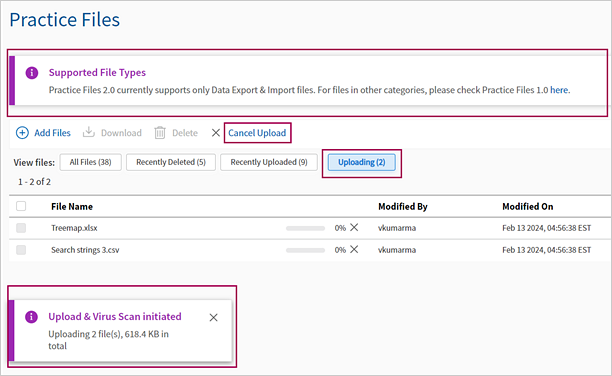
Note: A supported file types notification appears on the Practice Files 2.0 page.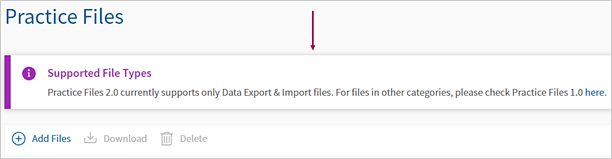
Note: athenaOne automatically scans files for viruses during upload. Files that pass the scan are uploaded to Practice Files 2.0. If harmful software is detected, the file is blocked and is not uploaded or saved in Practice Files 2.0.
Importing legacy documents using AI
For eligible imports projects, you can upload one or more archives of legacy documents without preparing a separate import metadata file. AI extracts patient demographic information and document file paths from the documents. You work with your Imports PM to review and reconcile patient matching results.
Note: This workflow has limited availability and is not self-service. You need athenaOne access, the Billing Admin: Practice Files permission, an open imports project, and an Imports PM. Contact your CSM or Onboarding project team to confirm eligibility or request a project.
Prepare your documents
- Package the documents in one or more
.zipor.7zarchives. For this AI-powered workflow, keep each archive at or below 4.8 GB. Contact your Imports PM or athenahealth team to discuss options if the total volume exceeds 50 GB. - Organize documents into a separate folder for each patient, or use consistently structured document filenames that include patient identifiers.
- Supported document types are PDF, BMP, PNG, JPG, JPEG, GIF, and TIFF. TIFF processing can vary depending on the file's formatting.
- Each document must be no larger than 175 MB and contain no more than 700 pages.
- Other document types are not supported by this workflow, including TXT, DOC, DOCX, HTML, audio, and video files.
Document metadata
You can provide an optional document index file or use information from consistently named files to manually populate additional document metadata in the import file. Without this additional information, the following defaults apply:
- Document date: 01/01/1900, or a value you define.
- Document category: Historical Medical Record.
- Document title: The filename as provided.
Work with your Imports PM if you want to supply additional document metadata. The AI-powered workflow does not require you to prepare the separate metadata file used by the indexed C-CDA workflow.
Upload and review the import
- Confirm your project's eligibility and coordinate the import with your Imports PM. If you do not have an Imports PM, contact your CSM or Onboarding project team.
- Export the documents from your legacy EHR and prepare the archives using the requirements above.
- Upload the archives using To upload practice files. Confirm the appropriate upload category and type with your Imports PM.
- After the uploads finish, notify your Imports PM that the archives are ready in Practice Files 2.0. Your Imports PM submits the archives for processing.
- If you want to add document metadata, work with your Imports PM to include information from an optional index file or consistently named files.
- Review the logs you receive for documents that partially match or do not match patients in athenaOne. Reconcile the information with your Imports PM and verify that the documents are associated with the appropriate patient records.
If your documents cannot be processed using this workflow, discuss alternatives with your athenahealth team. Options may include the Documents Self-Service add-on, which requires a high level of technical expertise, a data conversion vendor, or manual uploads to patient charts.
Step-by-step instructions
To search practice files
- You can search for practice files by entering one of the following in the search bar:
- File name
- Part of a file name
- User name
- Part of a user name

Note: A minimum of 3 characters is required to search for practice files, while entering in the search bar.
- Click Reset All to reset your search selection.

Advanced filters for practice files
You can now select the appropriate practice files using the filters. For completed Manage Data Exports jobs, use the Category and Type filters to locate the generated export files.
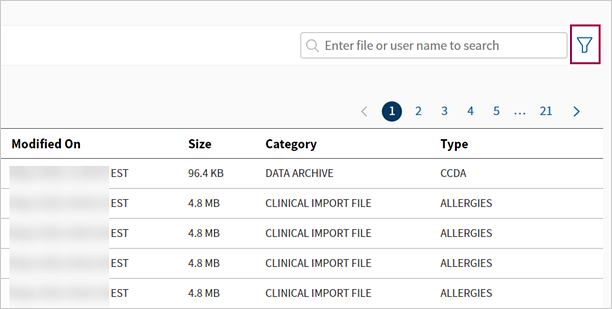
- Select the filter icon
 to open the Advanced Filters window.
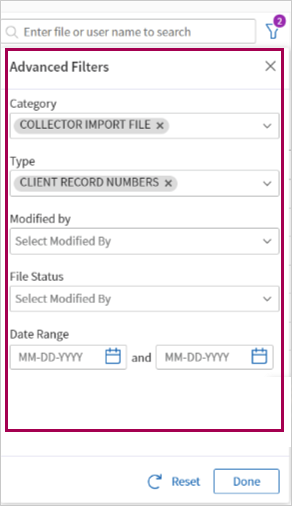
- Category — Select the categories of the practice file from the drop-down list.
- Type — Select the types of the practice file from the drop-down list.
- Modified by — Select the users who have modified the practice file from the drop-down list.
- Filter Status — Select this option to view files that have been downloaded or not downloaded.
- Date Range — Select the date range within which the practice file was created.
- Select Apply to close the Advance Filters window.
- Select Reset to clear your filters.
- You can view the total number of filters applied in the filter icon or in the message displayed.
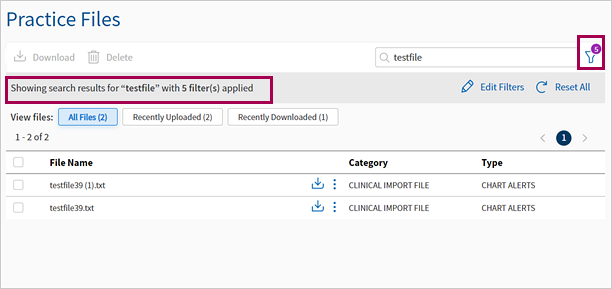
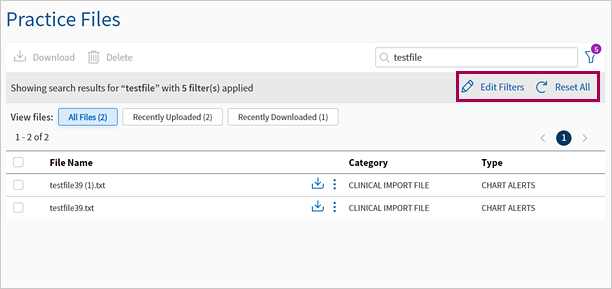
- Select Edit Filters to modify the filter fields.
- Select Reset All to clear your search and filters.
To download practice files
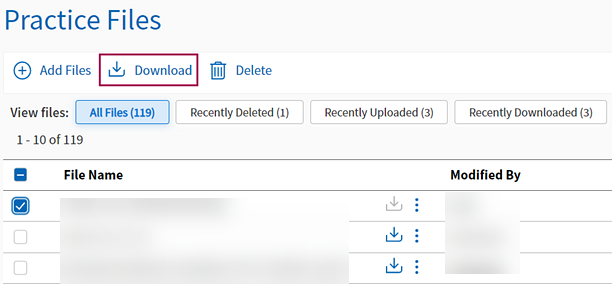
- Check the box next to each practice file to select multiple practice files.
- Click Download to download the selected files.
- Or, click the Download icon next to a practice file to download a single practice file.

- Click Cancel Download to stop the downloads.
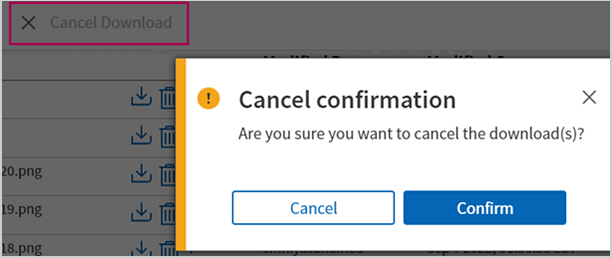
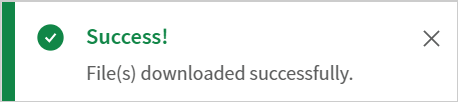
- After a practice file is successfully downloaded, a success message appears:
- For completed Appointments, Patient Demographics, EOBs, Transactions, Visit, Visit Charge, and Charge Detail export jobs, you can also click Download from Practice Files 2.0 from the Manage Data Exports page.
To upload practice files
-
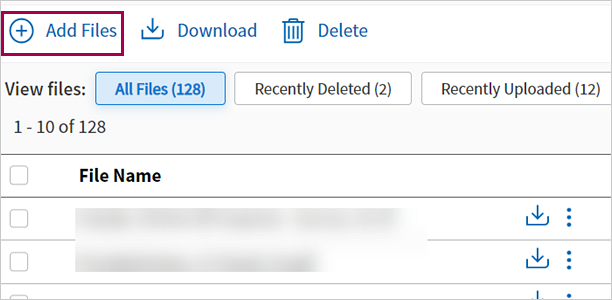
Click Add Files.
-
Select the appropriate file category from the Category - Required drop-down list. For indexed C-CDA document imports, select CLINICAL IMPORT FILE.
-
Select the appropriate file type from the Type - Required drop-down list. For indexed C-CDA document imports, select DOCUMENTS.
For AI-powered document imports, confirm the category and type with your Imports PM. After uploading the archives, notify your Imports PM so they can submit them for processing.
For problem code import files, select the category and type specified for your import project. Problem code imports support SNOMED, ICD-10, and IMO codes or terms.
Click Browse and select one or more files to upload from your local drive.
Important: You can add more files to upload by repeating steps 2-4 for different categories and types. You can upload up to 15 files at once.
The following image shows a different set of Category and Type ready for upload.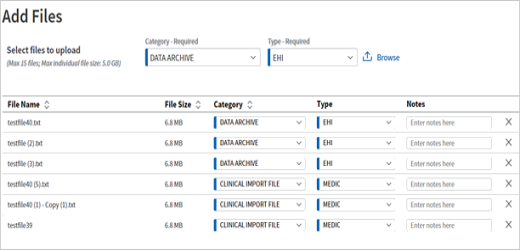
-
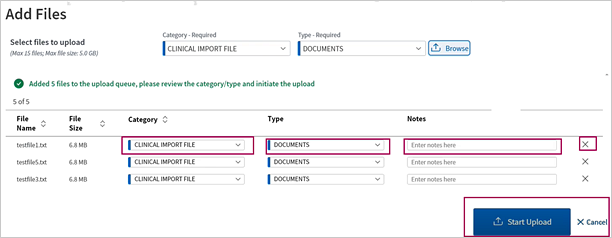
You can now view the files selected for upload.
-
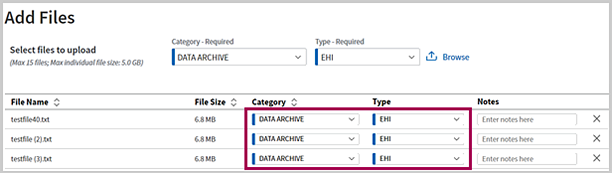
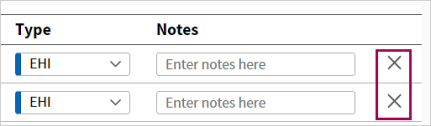
Change the Category and Type of the selected file by using the drop-down menus.
-
Add applicable notes (if required) in the Notes box.
-
Click the X icon to remove the file.
-
Click Cancel to cancel the uploads and go back to the landing page.
-
Or, click Start Upload to upload the files.
-
You can now view the status of your uploads on the Uploading tab. athenaOne scans each file for viruses during upload.
-
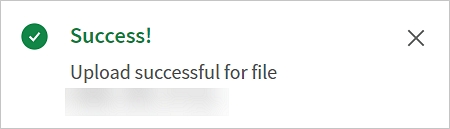
A success message appears, when a file has been successfully uploaded into Practice Files 2.0.
-
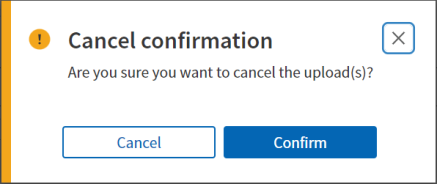
To cancel uploading of files, click Cancel Upload and select the files that you do not want to upload:
- Click on the
 icon to cancel individual file uploads.
- Choose files and click Cancel Upload to bulk cancel file uploads.
- Click Confirm to proceed with cancellation.
- Click on the
To review failed uploads
- Click the Failed Uploads tab to view the files and failure reason.
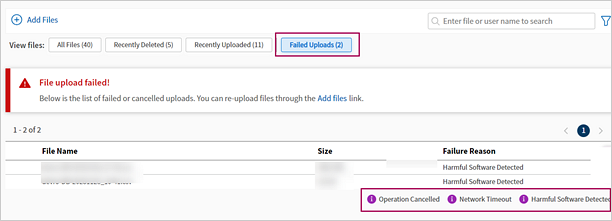 Note: If the reason is Harmful Software Detected, athenaOne blocked the file because the virus scan detected potentially harmful content. The file was not uploaded or saved in Practice Files 2.0.
- For more information related to the other failure reasons, hover over the respective
 failure reason icon.
To delete practice files
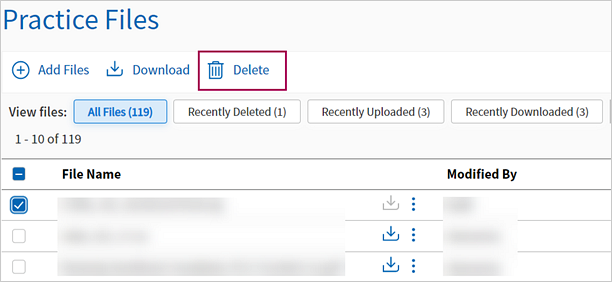
- Check the box next to each practice file you want to delete to delete multiple files.
- Click Delete.
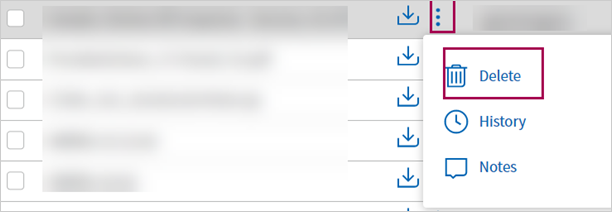
- Or, click the
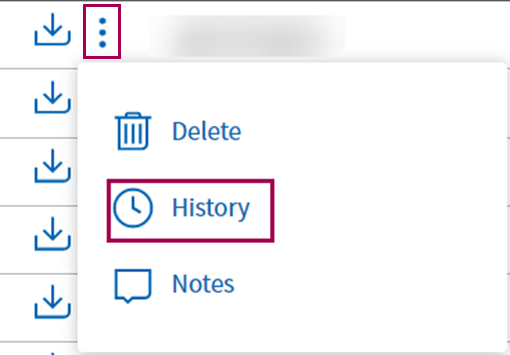
 icon and then click the Delete icon to delete a single practice file.
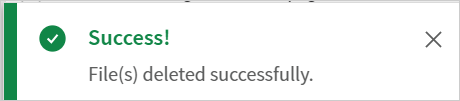
- A success message appears when the files have been successfully deleted from Practice Files 2.0.
To view audit history
- Select the icon.
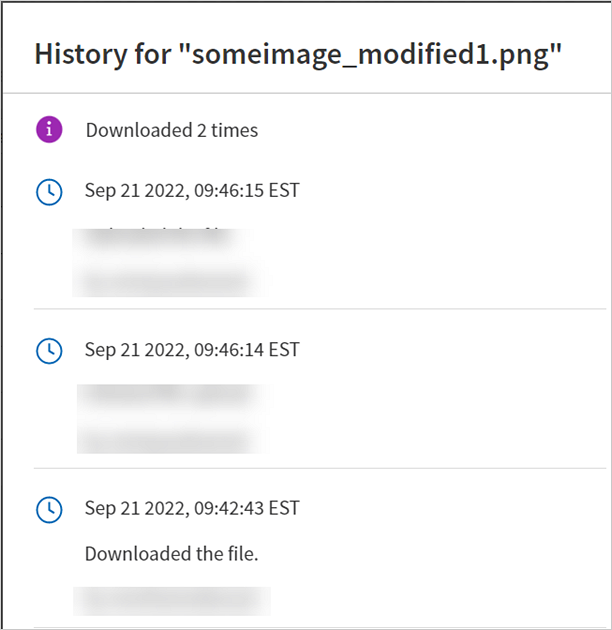
- Click History to view the audit history of the corresponding file.
Practice files quick filters
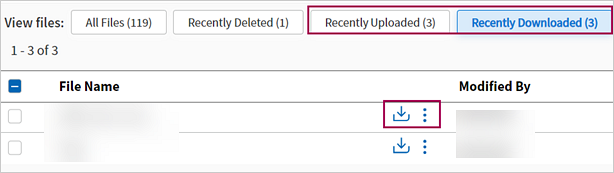
- Select the Recently Deleted tab to view the list of files that were deleted in the last seven days.
- Select the Recently Uploaded tab to view the list of files that were Uploaded in the last seven days.
- Select the Failed Uploads tab to view files that could not be uploaded successfully. If the reason is Harmful Software Detected, athenaOne blocked the file because the virus scan detected potentially harmful content.
- Select the Recently Downloaded tab to view the list of files that were downloaded in the last seven days.
- Select the Selected (X) tab to view the list of selected practice files.

Important: You can only perform the download and delete operations in the Recently Downloaded and Recently Uploaded tabs.